My new husband and I are back from our European odyssey that included stays at our childhood homes, a wedding and a family reunion, a honeymoon, and making memories that will take many years to process and fully appreciate. Our wedding was on the 70th anniversary of the end of a war in which our grandfathers were tasked with destroying each other by two homicidal madmen playing with tin soldiers. As we are both first-generation Canadians, our visits to the countries of our birth can be a walk through a minefield overgrown with wildflowers. In Germany, I was an enchanted traveller who saw and felt only the beauty and magic of a newly-discovered place. I often felt guilty, and still do, because I will never fully understand my husband's anxiety and sadness over visiting his home village and his relatives. For me it was a place of profound peace among rolling green hills that happened to be blessed with sunny weather during my entire stay. For him, it is the place where he spent his youth watching his mother die slowly of cancer, was plagued for years by a debilitating and painful injury, and fought many battles to acquire an education and a solid job. Maybe one day we will go to Russia together and he will give me a purely lighthearted view of my home; it would be interesting and useful to get such a perspective. There is value in such second-hand innocence.
The London where I grew up and that was the first stop on our journey has changed very little in 37 years; it was probably designed to require little or no change. The streets of London now have chain coffee shops, but the row house where we lived and St Mary Abbots school where I went look about the same; so does Holland Park. Also unchanged are the double-decker buses, and the nuclear simplicity of the British call to order: “Good dog owners pick up after their pet. Bad dog owners don’t.”

In Moscow people are getting less irritable and more attentive to creature comforts, bureaucracy is becoming simplified, and cars stop at designated crossings to give way to pedestrians. In the twelve days I spent in my childhood home visiting my mother and keeping either the radio or the TV turned on, the US was mentioned maybe twice, maybe three times. Canada, not once. Most political attention was divided between two topics. The first was Iran, its likely already developed nuclear weapons, its once and future empire, and what Russia should do about all this. The other topic was the sanctions imposed by the EU and how they’re pushing Russia to become self-sufficient. Cheese was a particularly hot topic. Russians are only beginning to master the production of fine cheeses that are no longer coming from France or Holland or Italy. A radio program invited callers to share their opinions about the cheese embargo. Most callers were patriots who agreed that they could survive without fine imported cheeses, which Europe could take and stuff you-know-where. One man called in and said, “I don’t really care for cheese, but I have to eat it, because I like wine, and there are certain kinds of wine that must be accompanied by cheese.” Many Russians disapprove of Putin, but not all for the same reason. Some disapprove of him because they think he’s cowardly, indecisive, and trying too hard to please the West. These people wish he’d sent real troops into the Ukraine for real, thereby preventing the bloodbath and the flack Russia is getting for it. A propos freedom of speech, I watched a movie named “Leviathan” that was released in cinemas in Russia last year with the abundant swearing bleeped out but otherwise uncensored. Filming was funded partly by the Russian Ministry of Culture. It’s somewhat like a French existentialist movie except that the existentialism is of the glum and despondent Russian variety. What amazed me was how the movie took a swipe at corruption and hypocrisy inside the Russian Orthodox Church. This would be like getting away with a swipe at the Communist Party during, say, the 70s.

Then it was on to Germany for me, starting with a tour of Köln, then visits to some towns on the Rhine and Mosel prior to our wedding in my husband’s home village. The castles and wines of the Rhine get plenty of coverage, but the smaller and slower river Mosel that meets the Rhine at the "German Corner" does not get many visitors any more. Most of them were Germans to begin with, and now they have less money for travel. Poor people are not readily obvious, they tend to hide from sight because poverty is embarrassing. However, camping in RVs on riverbanks is becoming popular, so a segment of people do have money. Of the castles we saw, Burg Eltz stands out in my memory (as well as on its rocky hill) for its harmony with nature. It is a fairytale vision reached after a walk through a forest that starts in the town of Moselkern. We met all of two people on our walk through this town from the train station, although there were several guesthouses, suggesting that this was once a tourist destination. This is not a ghost town, but a town of ghost guesthouses. We met Moritz and Paulchen, two solid cats cherished by their owner if not by each other. (We did see one or two raggedy feral cats in Germany; in Italy there were many more.) In Moselkern there is an abandoned 19th century wool mill by the stream, and an organization with enough money wants to restore it rather than letting it get torn down. I hope they succeed; an old factory is very romantic. Their endeavour is helped by the fact that real estate here is not worth very much. In this little haven on Mosel only tourists can be truly free of cares; the place is romantic only for them. We visited a winery and bought some lovely wine we meant to keep for the wedding but consumed much sooner, and learned from the owner about the heavy bureaucratic and tax burdens carried by small business owners. Waiting for the train and watching the sunset, we met two enormous swans and two impossibly cute Egyptian geese grazing on the lush grass on the bank of the river, the old and the new inhabitants of Moselkern. Globalization is hard at work in the animal kingdom.
Each castle in Germany is unique, but they all have one thing in common. A walk through the chambers (for "rooms" seems too modern a word) of any castle puts a chill into the core of your being that stays there for the rest of the day. Bring something warm even on a summer day. These places were once alive, and never thought they would become museums. The wood did not smell of dry rot as it does now, nor the stones of dust. People who lived here put up with much of what we consider unacceptable. They slept in sitting positions, afraid to resemble corpses if they lay down, or unable to pull enough air into their frail lungs in this position, and died from illness and wars in numbers that were often very high for their time. It takes quite a bit of arrogance topped with quite a bit of ignorance to claim that before our century no war had swept and decimated the entire known world. (Consider The Thirty Years’ War.) But that's all over now, and we know better. We have reached the pinnacle of civilization after a very long climb; some of the terrain was so shitty we wonder how people could live there. We are the party of climbers that made it, through no virtue of our own, only because we were born at the right time. We are the incredibly lucky, the redeemed, the washed every day with warm water and soap, the entitled to safety and happiness, and these castles are part of our heritage.

After the wedding we flew to Italy to imbue the lightness and warmth. Creative people go to Italy because the country is supposed to inspire them to create. I have no idea how writers manage to write there. In all my time in Italy I was hard-pressed to come up with words for so much as a journal, never mind ideas or sketches for a new story. The place took me over. It made me look, listen, smell and taste, but wouldn’t let me talk back. The scent of white acacia followed us from Liguria where we worked on a farm tending grapes and olive trees, to the island of Elba self-exiled from the mainstream tourist circuit, then to the gardens on the outskirts of Florence, and finally back to northwestern Germany where spring arrived after two months of our travels. In Pisa we took refuge from the heat and crowds in a botanical garden where pond turtles flocked to us in expectation of food. Not far from Cinque Terre in Liguria is the little town of Montemarcello on top of a hill overlooking the Gulf of Poets. (Ha ha, very funny. You’re supposed to write poetry as well as prose.) Montemarcello does not have world heritage status (that part of Italy has run out of quotas), so its narrow streets are empty of tourists. The hillside is covered by a forest of umbrella pines, chestnuts, and white acacias, the ground bulldozed by boars who root for nuts and wild onion bulbs by night and sleep in the thicket by day. In places there are mud puddles with imprints of fur from the boars’ bellies where they lay to cool off. At the foot of this hill the river Magra meets the sea, and in the distance, behind the heat and dust rising from the fields, the Apuan Alps rise like petrified clouds of gray and pink. The white patches on their slopes are not snow but the marble quarries of Carrara. The river valley is prone to flooding and drained by a system of channels straight as runways; swallows whistle the call of summer as they swoop back and forth along the channels in their hunt for insects. The banks are overgrown with wild yellow irises, and the water is home to a strange species that look for all the world like flying fish. They move in perfect wedge formations, skimming the surface of the water for food which they slurp up with their gaping mouths; you hear them before you see them. We watched two such formations work their way from opposite directions and meet head-on. They startled themselves terribly, all fish jolting in unison and producing a rustle and shimmer in the water. Not a moment later they re-grouped and swam off in one large flotilla. I don’t know if this is a native or a so-called invasive species, and if the latter, how it came to be here. The canals are also home to many coypu, animals that look like large guinea pigs with full white mustaches and penguin feet. These are definitely immigrants from South America. Despite their decent number, they are not hunted here. The cuteness factor is too strong, and the harm they do, if any, is not yet perceptible.
On Elba we stayed in a little house in a village with a meadow nearby, and after dark we listened to nightingales and walked through galaxies of tiny stars coming into being and fading in momentary bursts of white light: fireflies. These fireflies are different from the ones on the mainland; those have smaller and greener lights with a steady glow. The water that washes Elba is cold and very clean, but not too cold to swim in even in mid-May. A jellyfish stung my arm during one such swim; at first it felt like the sting of a wasp, but the salty water soon pulled out the venom. The mark it left was the shape of a large plump strawberry with the “seeds” being red spots from the jelly’s tentacles; they welted up right away and stayed red for a few days, but caused little bother. I have since googled this out and found that only a fried egg jellyfish could make such a sting pattern. Funny how I didn’t see this creature in the water; it is not as transparent as other jellies. Unfortunately, the mark it made on me has almost faded now. I would have liked to keep this accidental tattoo.

There is a great variety of coastal terrains on Elba. Behind Portoferraio the banks of the island are very steep, with a beach of dazzling white pebbles below. In Sant’Andrea fantastical rock formations make up moonscapes on the shore of the sea. The stone looks as if it’s made of crushed granite, with little perfectly rectangular inclusions that sparkle in the sun. Much tectonic grinding and mixing must have gone into the making of these rockscapes. Their surface is so smooth you could roll a ball over it, but not for any distance: they are arranged like whalebacks, with multiple chasms between the undulations. The cliffs that tower above are overgrown with hanging vines of bright magenta flowers. On the opposite side of the island, between Rio Marina and Cavo, there is a beach of shimmering black sand that ends in an outcropping of plum-purple rocks and the remains of a smeltery that could be very old. The mouth of an abandoned mine shaft looks like a small cave, and the rocks near it are frosted with sulphur-yellow and lime-green. We could find no seaweed or animals in the water off this beach; maybe the metals that make its rocks so beautiful are leaching into the sea and keeping living things away.
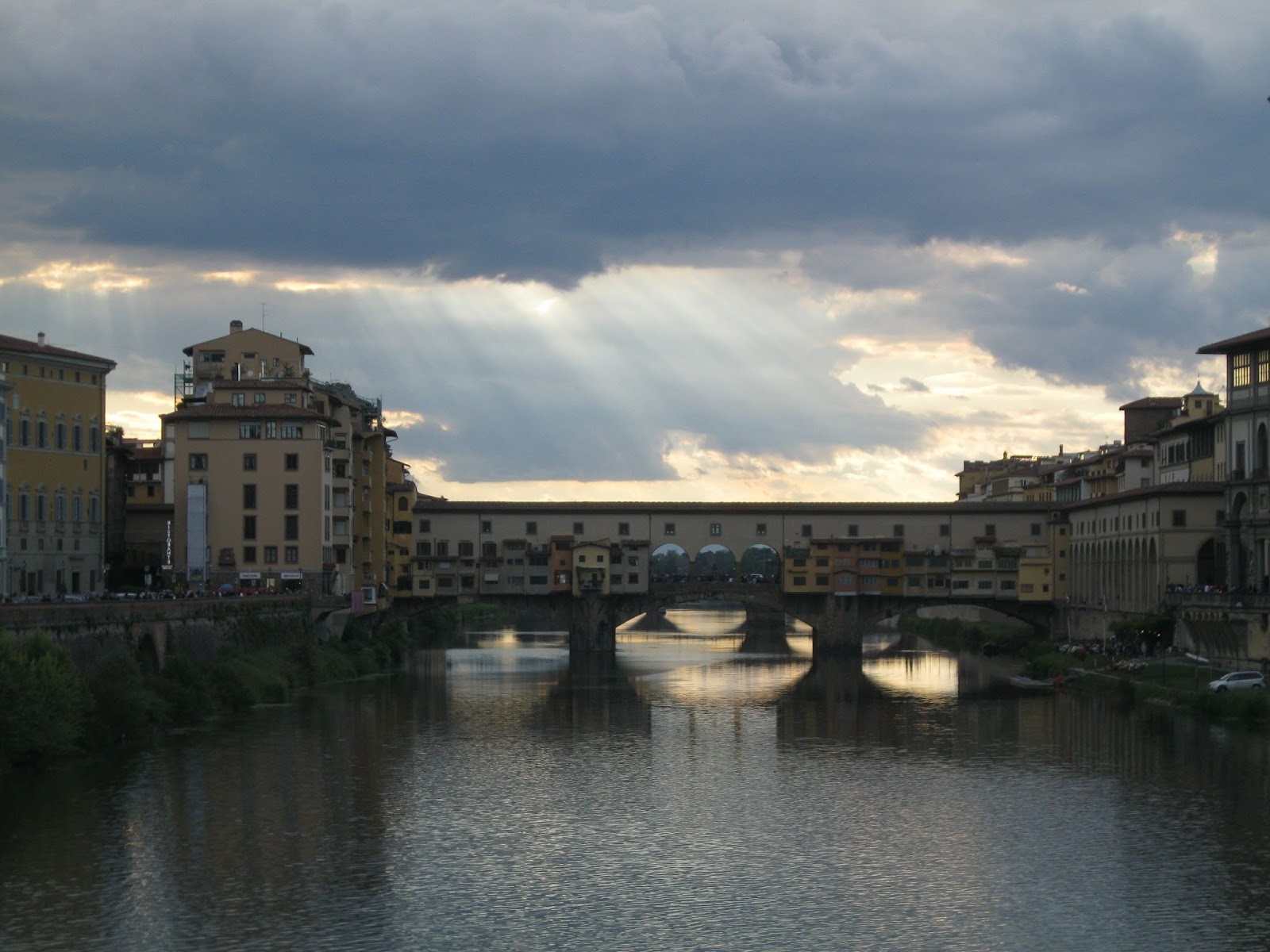
After Elba we came to Florence which I am hard-pressed to describe because of the multitudes of people it hosts even during “low” season. I am too easily distracted by people, by their appearance and their voices and by what they might be saying in languages I don’t understand. Their presence takes priority, and I am unable to tune it out even in the face of the most magnificent works of the Renaissance. But I will not forget the evening on the river Arno when the sun’s rays poured from under a solid gray cloud whose lower border was a perfectly straight line. And I will not forget our walk along Guelfa street (the name delighted me with its resemblance to my alma mater) when the buildings ahead of us became steeped in severe orange light. We turned around and saw the setting sun touching down on the road in the distance - at the vanishing point. We had found ourselves on this street unimportant by Florentine standards (although we seek out just such streets) in the year and on the day and at the moment the sun was to set in the narrow gully between the houses.

After Florence our paths diverged for a week. My husband flew back to Germany to spend more time with family and childhood friends while I (who speak hardly any German and feel like a deaf-mute if smiling idiot at such gatherings) did the slow crawl northward by train. I stayed at places he’d been to before, but that were new to me. There is a region of Italy around Lago Maggiore and to the east that, together with the Alps and the south of Bavaria, makes up the land of Rhaetia. This was once sort of a country, and it sort of still is. Here the deepest past, or what we call pre-history, lies closer to the surface than in other parts of Europe. Bicycling through a chestnut forest outside the town of Arona on Lago Maggiore, I came upon a lake that must be very old indeed. Now it is overgrowing with rushes and water lilies. Near this lake archaeologists found remains of the Golasecca culture: a boat made of a hollowed-out tree, pots, and cart wheels. The time interval indicated on the plaque was XV-VIII century B.C. What’s a mere seven hundred years’ difference, if history hasn’t yet started? As a linguist and a writer I wished these people could have left more written records of their lives. Why didn’t they describe themselves, draw attention to themselves? Well, they did. “For Latumaros and for Sapsuta, Naxian wine.” It doesn’t get more specific than that. No carrying on about feelings here.
My journey on the red train over the Bernina Pass was for the most part shrouded in fog; only toward Chur did the sky become clear and the sun come out. I never saw more than a small corner of Lake Poschiavo from the wuthering heights of the railway above it, and I saw nothing at all of the Alpine peaks and glaciers. I didn’t mind. There could have been anything in that mist. Fog conceals infinite possibilities, including another pilgrimage to this place sometime in the future. Out of the fog emerged names of stations, primal and feral names that sent a shiver down my spine. Scuol-Tarasp. Morteratsch. Bonaduz. Filisur. They are not pretty names, not the champagne-and-roses kind of romantic. They are almost menacing in their indifference to being admired, approved of. Maybe so were the people who once lived here. Mountains put a limit on silliness, gratuitous change, and the kind of ambition and indulgence you can get away with on the plains.
On the other side of the Alps my journey along the Romantic Street began in the unannounced and uncelebrated little town of Feldkirch. Inside the city walls is a building with a fresco of the founding and ruling fathers of the town, and the date 1218. Next to this building is a jewelry/curiosity shop displaying a fossilized sea lilly about 420 million years old. On a hilltop above the town is a wildlife park where I saw my first wild boars. Two of these proud and highly intelligent animals lay side by side on straw; they have nothing to do but lie about and eat. On the next morning I took a rather smelly diesel train named alex across Bavaria. In Landsberg I watched a trout propel itself into the air out of the swift river Lech, and wiggle frantically before flopping back into the water. He must have been doing it for sheer fun; there were no insects above the water to catch. A side channel of the Lech runs through the old city and washes the foundations of its houses much like a canal in Venice. That evening I arrived in the little town of Harburg after a thunderstorm that had driven people indoors. It was strange, in a brothers Grimm fairytale sort of way, to walk through an empty medieval town with a robust stone bridge over the quiet river. A multitude of snails had crawled out onto the paths, the large fat variety of edible snails once brought from France and accidentally set free. People slowly re-emerged from their houses as the evening sun came out, and on a walk to the other side of the Wörnitz river in search of sustenance I discovered a milk pavilion. A local farmer leaves fresh milk in the refrigerator, and a coin-operated dispensing machine pours out as much or as little as you pay for, into a bottle you bring with you. It tasted much like milk did in my childhood; but that was still warm from the cow. Rothenburg ob der Tauber, my next stop, gifted me with two surprises bordering on miracles. Although it is a large and very well-advertised city on the Romantic Street, the tourists on that day had all gravitated to the centre with its gingerbread houses and gilded shop signs, leaving the walkways along the walls and the spacious circular hospital tower empty. The next wonder was ten minutes of alone time with the Holy Blood altar by Tilman Riemenschneider, a story carved from lime wood that glows golden. Rothenburg is surrounded by forests and meadows, steeped in rural peace that begins right outside the city walls. In Ochsenfurt, a much smaller town and not on the official Romantic map, I got locked inside the City Hall after following the tourist brochure’s advice to look at the rooms. Most of the rooms have been modernized, but two looked like they haven’t changed in a few hundred years. The building is secular and mischievous. The painting on one of the ceiling beams shows a plump cherub peeing into a pot that a nymph is holding up for him. The front door was unlocked for me by a friendly clerk who was the second person to ask if I had an appointment with the mayor. Even with my broken German, that scenario must have seemed more likely than simply going in to gawk. From Ochsenfurt I travelled to my husband’s home village for a final stopover before our flight back to Canada. My last swim in Europe was in the chilly river Ruhr at the spot where my husband and his brother learned to swim some forty years ago. Downstream from a threshold of rocks the river deepens and the current quickens, bouncing you along for a few giddy seconds.

Many national stereotypes hold true, others are melting away together with borders. Both in Germany and in Italy people are under considerable strain to find work, pay taxes, and navigate an increasingly elaborate bureaucracy. England is part of the EU, but somehow also apart, somehow above it all. Russia is not part of anything and does not aspire to be, but its citizens are becoming 1920s’ Europeans in their tastes and expectations, and their TV programs are carbon copies of American reality TV. A lot of Europeans smoke a lot. Italians can be very passionate in their speech, but otherwise they are not easily rattled. Most are friendly and helpful if laconic, but the occasional few are capable of glacial indifference if they don’t have an answer to your question or don’t wish to give one. Germans, by contrast, vibrate with a sense of duty to respond to a traveller’s needs, and seem deeply if silently bothered if they are unable to do so to their own satisfaction. In this they are by far the more emotional nation. Of course there are regional differences. Bavarians, who were already gathering strawberries in late May, are prosperous, relaxed, and seem happy. Sauerlanders (my husband’s tribe) are sour from the cold foggy weather and from interaction with bureaucrats who are themselves sour because the government sent them here. Two thousand years ago these folk got sour enough to destroy three Roman legions, all of twenty thousand men, stumbling through the dense forest under a pouring rain to spread the empire eastward. Rome was never the same after that. And who knows what the rest of Europe, including Russia, would be like without that battle.
If Germans take comfort in duty, Italians place great trust in reflexes, theirs and yours. Car drivers trust other car drivers, bicyclists trust car drivers. Miraculously, this works more often than not. Oncoming drivers trust that you will react when their car comes round the bend with half of its ass in your lane. And, you do react. You discover in yourself neuronal agility that lies dormant and unused in more civilized driving conditions. This is absolutely unacceptable, exasperating, it will make you sweat proverbial bullets, and at the end of the day (or the month, or the year) you might just love these people for forcing you into excellence bordering on heroism. The only unbreakable traffic rule in Italy is, Can the Other Driver See You? If they can, proceed with whatever you must do. Because if you don’t, someone else will, and so on until the second coming, or until you’re honked and jostled into proceeding. Italians adore their vintage Fiat 500s, and well they should. If you think the new Fiat is small, take a look at one sitting beside the original model. There is a vintage Fiat 500 club on Elba, and well there should be: the lovable little buggers were made for just such terrain. These “antique” cars are super-lightweight and innocent in both appearance and function. Unlike the modern computers on wheels whose mission is to render their drivers coddled and helpless, these machines can be opened up, studied, understood, loved, cared for, and repaired. A 50 year-old Fiat station wagon put our brand-new rental Chevy Spark to shame on a descent of an Elban mountain road. But why should that be surprising? We’re the ones who demand constant re-invention of the wheel.